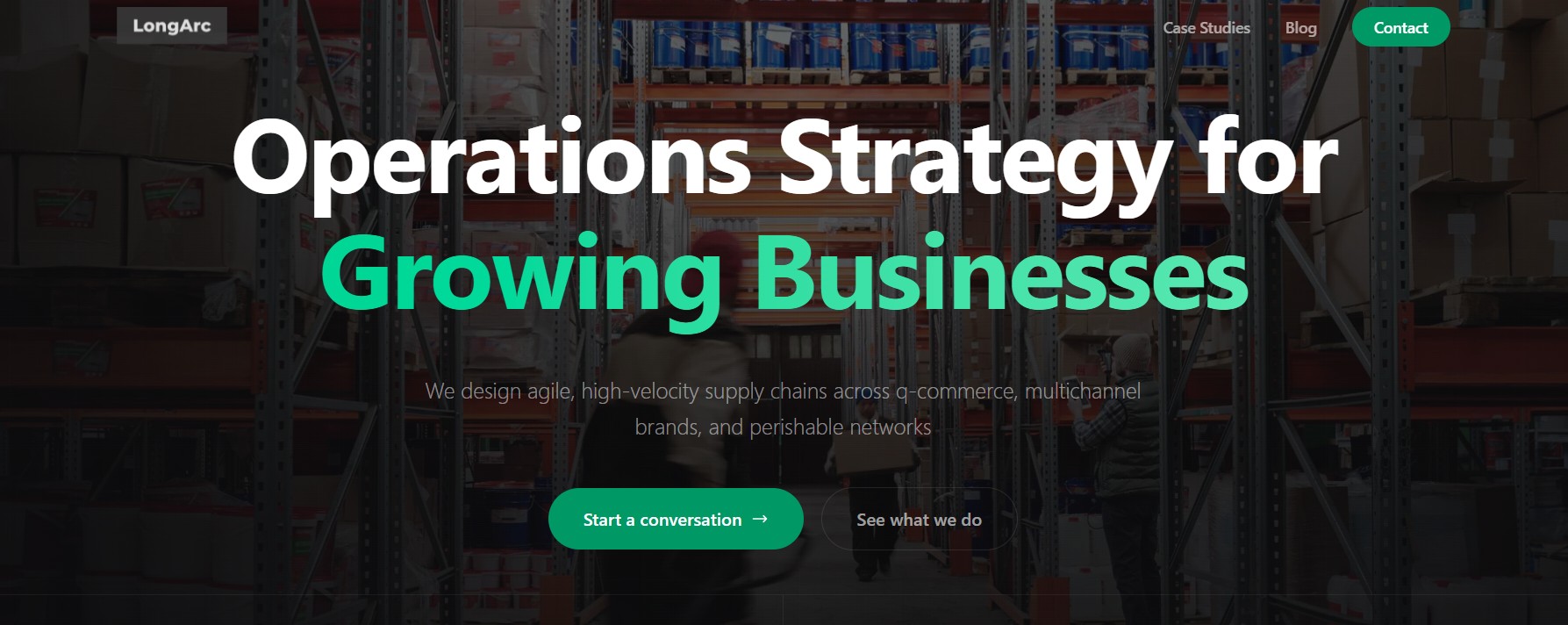
Case Study: SEO Optimization and CTA Functionality Improvements for LongArc (Supply Chain & Logistics)
Company: LongArc
Industry: Supply Chain & Logistics
Primary Goals: Improve organic visibility for high-intent logistics queries and increase lead generation through clearer, higher-performing calls-to-action (CTAs).
Background
LongArc operates in a competitive logistics market where prospective customers frequently begin vendor selection through search. The existing website contained valuable service information but underperformed in organic search and did not consistently convert visitors into qualified leads. CTAs were inconsistent across key pages, forms created friction, and several technical issues limited crawlability and indexation.
Challenges
- Low visibility on high-intent keywords related to freight solutions, warehousing, and route optimization.
- Misaligned content architecture that did not map cleanly to service lines and buyer intent.
- CTA inconsistency (varied labels, placements, and designs) causing unclear next steps.
- Form friction due to long fields, unclear value proposition, and weak confirmation flows.
- Technical SEO gaps including index bloat, thin pages, missing internal linking structure, and performance issues on mobile.
Objectives
- Increase organic traffic to service and solutions pages by targeting transactional, mid-funnel queries.
- Improve lead conversion rate through standardized CTAs, stronger messaging, and lower-friction forms.
- Strengthen site crawlability, page experience, and topical authority in logistics-specific themes.
Approach
1) SEO Audit and Opportunity Mapping
A full audit identified indexation and content gaps, along with conversion bottlenecks. A keyword and intent model was built around LongArc’s commercial offerings, segmenting terms into:
- Service-intent queries (e.g., “3PL warehousing services,” “freight forwarding partner”).
- Solution-intent queries (e.g., “cold chain logistics solutions,” “last-mile delivery optimization”).
- Industry-intent queries (e.g., “logistics for automotive suppliers,” “ecommerce fulfillment logistics”).
- Problem-intent queries (e.g., “reduce shipping delays,” “improve OTIF performance”).
2) Information Architecture and Content Restructuring
Navigation and page hierarchy were reorganized to match how buyers search and evaluate providers. Core improvements included:
- Service hub pages created for primary offerings (Freight, Warehousing, Distribution, Managed Transportation).
- Solution pages aligned to common operational problems and measurable outcomes.
- Industry pages built to demonstrate domain expertise and compliance requirements.
- Internal linking framework connecting services, solutions, industries, and case studies to consolidate authority.
3) On-Page SEO Enhancements
Priority pages were rewritten and optimized to improve relevance and click-through from search results.
- Title tags and meta descriptions updated with intent-driven language and value propositions.
- Heading structure standardized to support readability and topic coverage.
- Content expansion added where pages lacked decision-making details (process, service areas, constraints, timelines, differentiators).
- FAQ sections added to capture long-tail queries and reduce sales friction.
4) Technical SEO and Performance Fixes
- Indexation controls implemented to reduce thin/duplicate pages and tighten crawl budget.
- Redirect and canonical cleanup to consolidate legacy URLs and eliminate ambiguity.
- Image and asset optimization to improve mobile speed and page experience.
- Structured internal linking to ensure important commercial pages received consistent link equity.
5) CTA System Design (Messaging, Placement, and Consistency)
A CTA framework was implemented across all high-intent pages to guide visitors to the next step without confusion.
- Primary CTA standardized to “Request a Quote” for service pages and “Talk to an Expert” for solution pages.
- Secondary CTA introduced for earlier-stage visitors, such as “Download Capabilities Deck” or “See Use Cases.”
- CTA placement rules applied consistently: above the fold, mid-page after proof points, and near the bottom after detailed information.
- CTA microcopy adjusted to reduce anxiety (response time, what happens next, privacy reassurance).
6) Form Optimization and Lead Capture
- Field reduction to minimize abandonment while preserving qualification signals.
- Progressive profiling introduced through optional fields and follow-up steps rather than upfront requirements.
- Clear confirmation states implemented with next-step guidance and resource suggestions.
- Spam protection added without introducing high-friction challenges.
7) Measurement and Experimentation
Tracking was aligned to SEO and conversion outcomes to ensure decisions were evidence-based.
- Event tracking for CTA clicks, form starts, form submits, phone/email interactions, and brochure downloads.
- Funnel reporting to identify drop-off points by page type, device, and traffic source.
- A/B tests run on CTA copy, button hierarchy, and form length to validate improvements.
Results
After implementation, LongArc achieved measurable improvements across acquisition and conversion performance:
- Organic traffic growth driven by improved rankings on commercial-intent service and solution queries.
- Higher engagement on restructured hub pages due to clearer navigation and stronger internal linking.
- Improved conversion rate from organic and direct traffic due to consistent CTA placement and reduced form friction.
- More qualified leads attributed to better intent matching, clearer service positioning, and improved follow-up flow.
- Better mobile performance supporting stronger conversion outcomes for on-the-go decision-makers.
Key Deliverables
SEO Strategy
Keyword-to-page mapping, intent model, and content roadmap aligned to revenue-driving offerings.
Information Architecture
Service hubs, solution pages, industry pages, and a scalable internal linking plan.
On-Page Optimization
Rewritten titles, metadata, headings, expanded copy, and FAQ modules on priority pages.
Technical Improvements
Indexation cleanup, redirect/canonical fixes, and performance enhancements.
CTA & Form System
Standardized CTA language and placement, improved forms, and clearer confirmation states.
Analytics & Testing
Conversion event tracking, funnel reporting, and structured experimentation plan.
What Made the Biggest Difference
- Intent alignment: Pages matched how logistics buyers search, compare, and qualify vendors.
- Consistency at scale: A repeatable CTA system reduced cognitive load and improved navigation toward conversion.
- Reduced friction: Shorter forms and clearer next-step messaging improved completion rates.
- Authority building: Interlinked hubs, solutions, and proof points strengthened topical relevance and rankings.
Recommended Next Steps
- Expand content into a structured library of operational guides (OTIF, claims reduction, cost-to-serve, network design).
- Create additional case studies focused on measurable outcomes (lead time reduction, damage reduction, inventory turns).
- Build location and coverage pages where applicable to capture regional logistics intent.
- Continue CTA and form testing by segment (industry, company size, shipment profile) to increase lead quality.
Outcome: LongArc’s website evolved from a brochure-style presence into a search-visible, conversion-focused acquisition channel by pairing SEO fundamentals with a disciplined CTA and lead-capture system.
Case study prepared for LongArc (Supply Chain & Logistics) focusing on SEO optimization and CTA functionality improvements.

See this project live.
LongArc