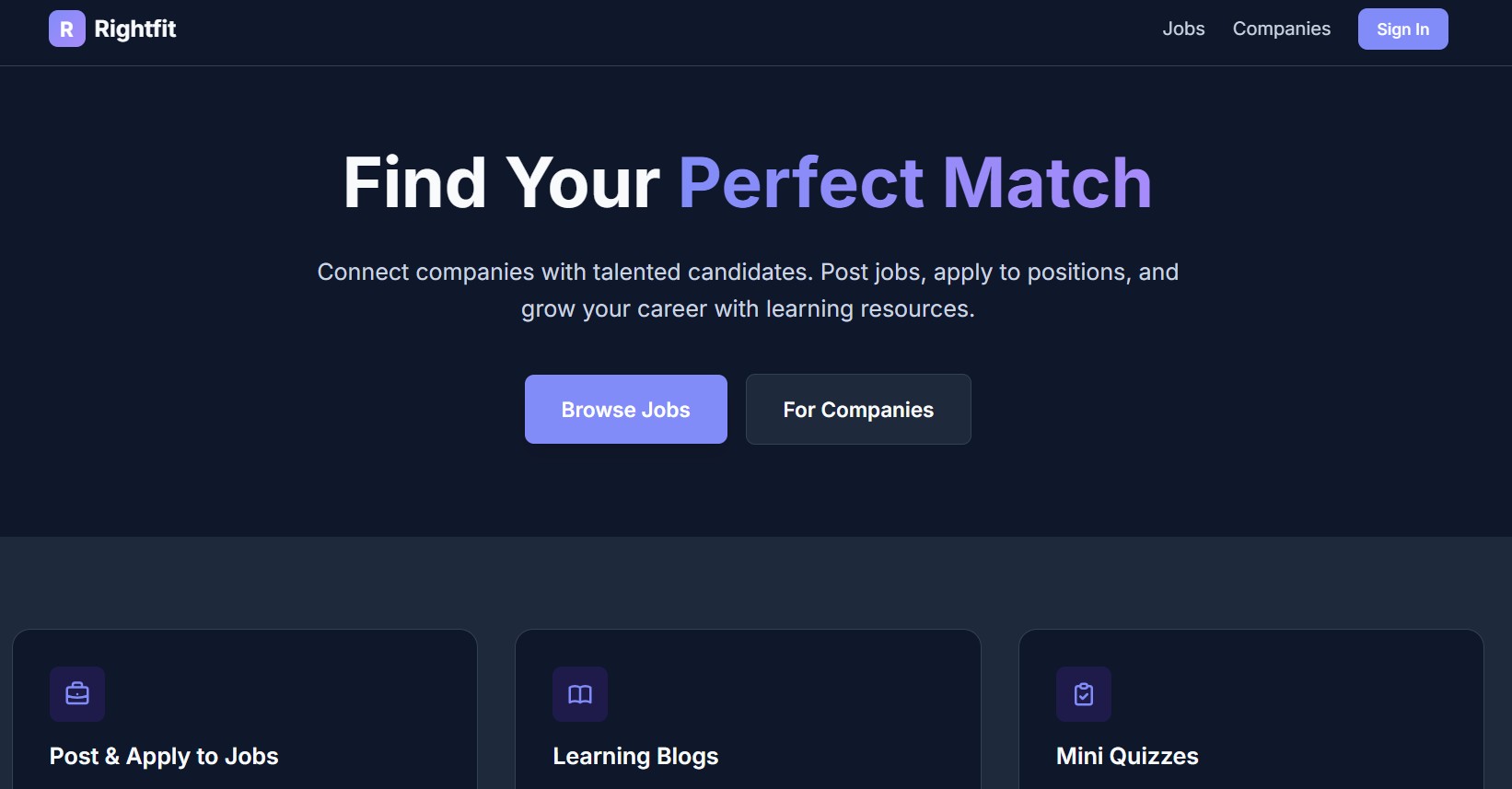
Case Study: Rightfit — AI-Powered Hiring Platform with Quizzes and Job Matching
Rightfit is a hiring platform designed to improve candidate-role fit by combining structured assessments, AI-assisted evaluation, and intelligent job matching. The product experience integrates role-specific quizzes, skills validation, and automated shortlisting to reduce time-to-hire while increasing hiring quality.
Overview
Industry
Recruitment technology (HR tech / talent acquisition)
Primary users
Recruiters, hiring managers, candidates
Core capabilities
Quizzes and assessments, AI scoring, matching engine, structured workflows, analytics
Success metrics
Time-to-shortlist, interview-to-offer ratio, quality-of-hire signals, candidate completion rate, recruiter workload reduction
Challenge
- Low-signal resumes: keyword-heavy CVs and inconsistent job titles made screening noisy and slow.
- Mismatch risk: candidates passed basic criteria but failed in-role tasks or team expectations.
- Manual bottlenecks: recruiters spent large portions of time scheduling, screening, and repeating the same qualification questions.
- Candidate drop-off: long, generic application flows reduced completion rates and harmed employer brand perception.
Goals
- Improve fit using objective, role-relevant evidence rather than CV heuristics alone.
- Accelerate shortlisting by automating early-stage evaluation and surfacing top candidates faster.
- Standardize screening to reduce bias and improve consistency across hiring teams.
- Increase application completion with tailored, mobile-friendly, short assessment experiences.
Solution
1) Role-Based Quizzes and Micro-Assessments
Rightfit introduced short, role-specific quizzes that evaluate practical skills, job knowledge, and reasoning. Assessments were designed to be completed in minutes and structured into question banks aligned to competencies.
- Question types: multiple choice, scenario judgment, short response, work-sample prompts.
- Adaptive routing: follow-up questions based on previous responses to increase signal while keeping time low.
- Anti-cheat safeguards: randomized question sets, timeboxing, integrity checks.
2) AI Scoring and Evidence Summaries
An AI layer supported evaluation by summarizing candidate responses into structured evidence, highlighting strengths, and flagging areas requiring follow-up. Final decisions remained with hiring teams, while AI reduced repetitive reading and note-taking.
- Scoring rubric alignment: scores mapped to predefined competencies per role.
- Explainability: each score included supporting excerpts and assessment evidence.
- Bias controls: evaluation grounded in responses and skills signals rather than demographic proxies.
3) Matching Engine for Candidate-to-Role Fit
Rightfit combined quiz results, skills taxonomy, experience signals, preferences, and role requirements to generate a fit score and ranked matches.
- Multi-factor matching: skills, seniority, domain experience, location/remote preferences, compensation expectations.
- Weight controls: configurable role weights (e.g., skills 50%, domain 20%, communication 15%, availability 15%).
- Bidirectional matching: candidates received recommended roles; recruiters received ranked shortlists.
4) Workflow Automation and Collaboration
Recruiter and hiring-manager workflows were streamlined with automation and standardized decision points.
- Auto-shortlisting: threshold-based advancement with human review controls.
- Structured interview kits: question packs tied to assessment gaps.
- Team feedback: scorecards, comments, and decision logs to reduce back-and-forth.
5) Candidate Experience Enhancements
- Fast apply: reduced form fields, profile import, and one-click reapply across roles.
- Transparent progress: clear steps and estimated time to complete.
- Personalized feedback: optional skills insights and learning resources post-assessment.
Implementation Approach
Discovery
Stakeholder interviews, funnel analysis, screening audit, and competency mapping per role family.
Design
Assessment blueprint, rubric definition, candidate journey redesign, and recruiter workflow mapping.
Build
Quiz engine, scoring services, matching model, recruiter console, and analytics dashboards.
Validation
Pilot with select roles; calibration sessions to tune weights, thresholds, and rubric consistency.
Rollout
Gradual expansion by department; monitoring for drop-off, fairness, and performance drift.
Key Features (Platform Highlights)
- Assessment Library: reusable quizzes by role, seniority, and competency.
- AI Candidate Brief: standardized summary with strengths, risks, and recommended interview probes.
- Fit Score and Ranking: transparent scoring breakdown and match explanations.
- Interview Kits: targeted questions generated from assessment results.
- Analytics: funnel conversion, completion rate, time-to-stage, and role calibration reports.
- Integrations: ATS sync, calendar scheduling, email templates, and webhook-based automation.
Results (Illustrative Outcomes)
- Faster shortlisting: reduced screening time by prioritizing high-signal candidates earlier.
- Higher interview quality: more structured interviews driven by evidence and competency gaps.
- Improved fit: fewer late-stage mismatches due to earlier validation of role-critical skills.
- Better candidate completion: shorter, tailored assessments increased application completion rates.
What Made Rightfit Different
Rightfit focused on measurable job-relevant signals—turning hiring from document review into evidence-based matching.
- Evidence over keywords: quiz performance and work-sample signals reduced reliance on CV filtering.
- Configurable by role: rubrics, weights, and thresholds adjusted to match hiring realities.
- Human-in-the-loop: AI accelerated decisions without removing accountability from hiring teams.
Future Enhancements
- Skill graph expansion: deeper taxonomy mapping across industries and emerging roles.
- Team-fit signals: structured collaboration and working-style assessments with clear guardrails.
- Continuous calibration: drift detection, fairness monitoring, and periodic rubric refresh cycles.
- Candidate talent wallet: reusable verified skills profile to reduce repeated assessments.

Services used
See this project live.
Visit Site